1. Introduction: Escaping the Metabolic Gray Area
My name is Adam, and for years, I found myself completely paralyzed by profoundly contradictory nutritional advice. On one side of the spectrum, the plant-based longevity camp insisted that we must eat a low-protein diet because “meat causes cancer” and dietary amino acids accelerate aging by keeping the body in a constant state of growth. On the exact opposite side, the fitness and carnivore communities insisted that I needed to eat 200 grams of protein a day because “red meat is a superfood” and muscle mass is the ultimate organ of longevity.
This contradiction led me down a deep journey into the scientific literature, and what I discovered is that both groups are partially right—and partially wrong. The plant-based camp is correct that chronic cellular growth inhibits cellular cleanup (autophagy) and accelerates aging. The high-protein camp is correct that without robust muscle mass, we succumb to frailty, metabolic disease, and physical decline.
The underlying conflict revolves around the inverse relationship between two master metabolic regulators in our cells:
- mTORC1: The driver of anabolism, muscle protein synthesis, and cellular growth.
- AMPK: The energy sensor that promotes catabolism, fat burning, autophagy, and cellular repair.
Under normal circumstances, these regulators operate like a seesaw. When we eat, mTOR goes up and AMPK goes down. When we fast and exercise, AMPK levels rise and actively shut down mTOR to conserve energy.
The problem is that most people—whether following a standard American diet or a traditional bodybuilding diet—live in a “metabolic gray area.” By constantly grazing, eating frequent meals, or consuming moderate amounts of protein and carbs all day, they maintain chronic, low-level mTOR activation. Because of this chronic elevation, they never achieve the profound, restorative depths of full AMPK activation required for cellular cleanup. Conversely, because their mTOR is constantly humming in the background, they become somewhat desensitized to it, never achieving a massive, pristine anabolic spike for muscle growth.
My research has led me to believe that the missing piece of the puzzle is modulating between these extremes. Instead of living in the gray area, we should spend most of our time in a state of very high AMPK activation (deep fasting), punctuated by brief, targeted periods of very high mTOR activation (anabolism), and then immediately switch back.
Through my own “N of 1” experimentation, I developed a time-restricted protocol that does exactly this. By strategically using Beta-Hydroxy-Beta-Methylbutyrate (HMB) and Phosphatidic Acid (PA) pre-workout, followed by an intra-workout bolus of Essential Amino Acids (EAAs), and concluding with a strict 3-hour fast, I isolate the exact triggers required to intensely stimulate muscle growth while allowing AMPK to rapidly re-establish dominance post-workout.
2. The Baseline: Why Fasted Lifting is Inherently Catabolic
My day starts between 3:00 and 4:00 AM in a deeply fasted, low-insulin state. While this hormonal environment is highly conducive to fat oxidation, it is an incredibly hostile environment for skeletal muscle.
Muscle mass is dictated by the net balance between Muscle Protein Synthesis (MPS) and Muscle Protein Breakdown (MPB). In a fasted state, your baseline MPS is depressed. When I lift weights for roughly 1.5 hours (typically between 5:00 and 7:00 AM), the mechanical tension of lifting stimulates the signal for MPS. However, without exogenous amino acids available in the bloodstream to serve as building blocks, actual tissue growth cannot occur. Worse, the intense mechanical disruption of the muscle fibers, combined with elevated cortisol from the workout, causes a drastic amplification of MPB.
During this time, the energy sensor AMPK becomes highly active due to the depletion of cellular energy (ATP). Once maximally activated, AMPK acts as a metabolic roadblock. It phosphorylates (modifies) specific proteins that effectively lock mTOR in the “off” position to conserve energy. To grow muscle without breaking my fast, I needed a way to bypass this AMPK roadblock.
3. The Pre-Workout Primer (~45 Mins Prior): Bypassing the Blockade
To counteract the catabolic environment without breaking my fast—meaning no insulin spikes or caloric bulk—I take Phosphatidic Acid (PA) and HMB roughly 30 to 45 minutes before lifting.
3.1 Phosphatidic Acid (PA): Forcing mTOR Activation
Under normal fed conditions, the hormone insulin activates mTOR. In my fasted state, insulin is dormant. However, skeletal muscle possesses an alternative, mechanically sensitive pathway for growth.
When I lift weights, the mechanical tension induces the local synthesis of PA within the muscle cell. PA acts as a direct lipid messenger. By supplementing with exogenous PA pre-workout, I provide the exact molecule needed to physically bind to a specific receptor on mTOR (the FRB domain). This direct physical interaction mechanically forces mTOR into an active state, completely bypassing the need for insulin, calories, or systemic energy abundance.
3.2 HMB: The Anti-Catabolic Shield
While PA acts as the anabolic catalyst, it doesn’t stop the body from tearing down existing muscle. During a fasted workout, the lack of nutrients upregulates the ubiquitin-proteasome system, a cellular pathway that degrades muscle tissue for fuel.
HMB functions as an anti-catabolic shield. It works by modifying a transcription factor called FoxO3a, effectively trapping it outside the cell’s nucleus. This silences the “atrogenes” (muscle atrophy genes) and drastically reduces MPB. Crucially, because HMB is a non-caloric metabolite, it achieves this without elevating blood glucose or inducing an insulin spike, leaving my fasted state intact.
3.3 Addressing the Skeptics
It is important to acknowledge recent academic counterarguments. Several meta-analyses and randomized controlled trials have shown that PA and HMB supplementation often fail to produce significant differences in muscle thickness or strength compared to a placebo in well-fed, resistance-trained men.
Critics use this to dismiss these supplements entirely, but they miss the physiological context. Those studies test subjects consuming massive caloric surpluses with high daily protein intake. In a fed state, mTOR is already maximally stimulated by insulin and dietary amino acids, and muscle breakdown is already suppressed. In that environment, PA and HMB are absolutely redundant.
However, the International Society of Sports Nutrition (ISSN) notes that HMB’s efficacy shines specifically when the body is under severe catabolic stress—like caloric restriction or fasting. My protocol places my body in a deeply fasted, glycogen-depleted state where systemic anabolism has bottomed out. Under these specific conditions, PA and HMB transition from being redundant supplements to being absolute necessities for preserving lean mass and triggering mechanical mTOR activation.
4. The Intra-Workout Catalyst (30 Mins Before Finishing): 15g Free-Form EAAs
While PA mechanically primes mTOR and HMB halts breakdown, actual tissue accretion cannot occur without the raw materials: amino acids. Exactly 30 minutes before the end of my workout, I consume 15 grams of free-form Essential Amino Acids (EAAs).
4.1 The Anabolic Threshold and Insulin Kinetics
I specifically use free-form EAAs rather than a whole protein source (like whey or a meal) because they require virtually no gastric digestion. They rapidly enter the peripheral circulation and are shuttled directly to my hyperemic (blood-engorged) muscles.
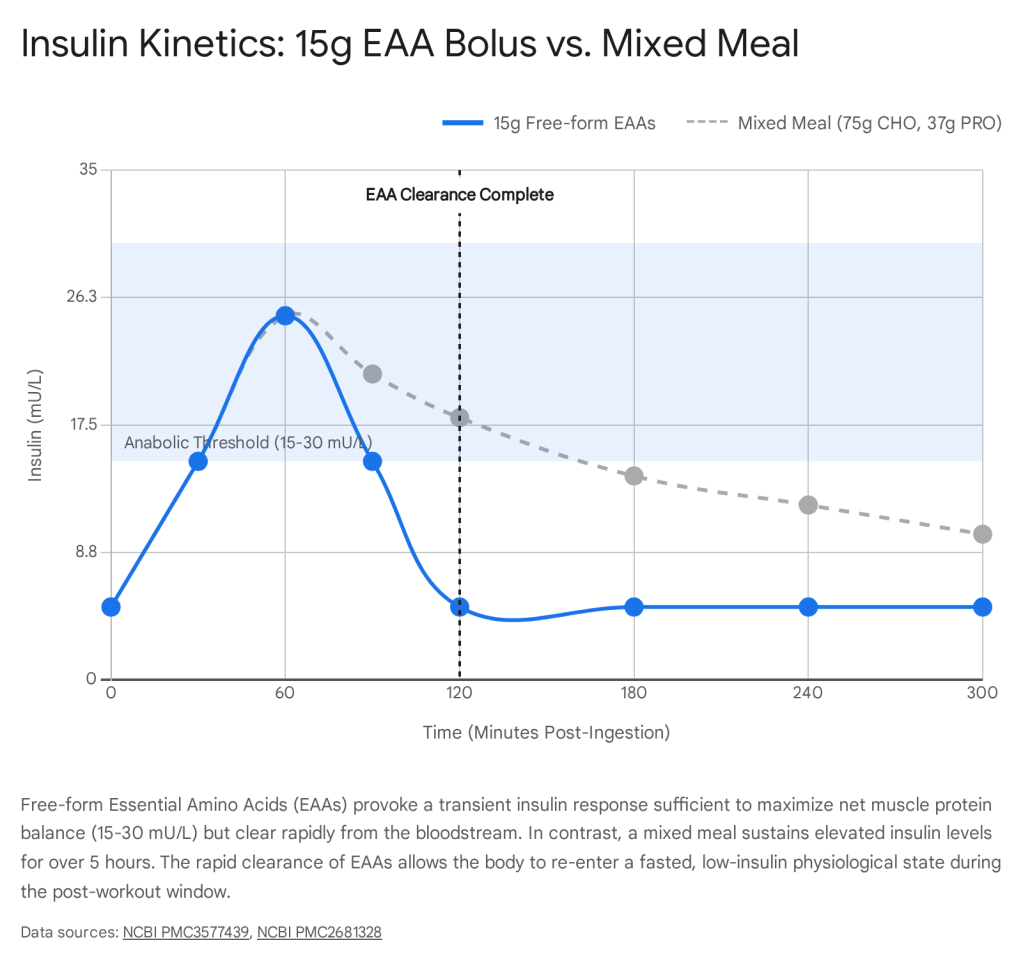
Because these EAAs contain zero carbohydrates and zero fat, their insulinogenic effect is isolated solely to the amino acids themselves (primarily leucine). A 15g EAA bolus briefly pushes systemic insulin into the optimal “anabolic threshold” of 15–30 mU/L. This is just enough to facilitate translation initiation for muscle growth without the excessive, prolonged hyperinsulinemia caused by traditional meals. Most importantly, the EAAs are cleared from my bloodstream exceptionally fast, allowing insulin to plummet back to baseline typically within 60 to 120 minutes.
4.2 Preserving AMPK Signaling
A pervasive myth in intermittent fasting communities is that any introduction of amino acids immediately and permanently shatters the fasted state. However, because my muscle remains in a state of profound energy deficit and glycogen depletion, the underlying biological drivers of AMPK activation remain dominant. The transient, minor insulin spike from the EAAs is sufficient to trigger the muscle-building machinery, but it is too small and too brief to chronically override the robust, exercise-induced AMPK signal.
5. The Post-Workout Fasting Window (A Strict 3 Hours): The Catabolic Cleanup
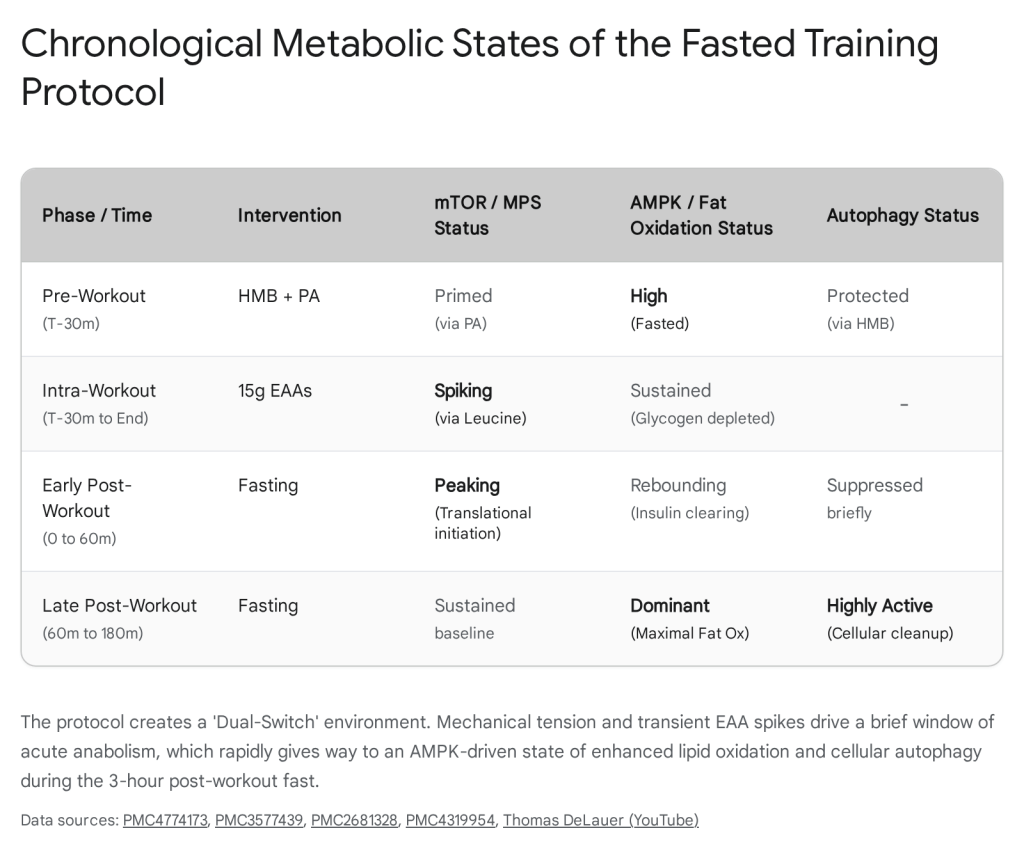
Following the workout, I deliberately enter a strict 3-hour fasting window before my first meal. This 180-minute period is where the true “metabolic flexibility” of my protocol shines. The physiological switch flips from a brief, intense pulse of anabolism back to a sustained state of catabolic cleanup.
5.1 The AMPK Rebound and Autophagic Clearance
As the EAAs clear my system, systemic insulin drops back to its fasting baseline, completely lifting any transient inhibition on adipose tissue (fat) lipolysis. With AMPK activity rebounding and local muscle glycogen deeply depleted, my body is forced into a state of maximal fat oxidation.
Simultaneously, intense lifting causes microscopic damage to muscle fibers and mitochondria. To repair this tissue optimally, the cellular debris must be cleared through macroautophagy (cellular cleanup). Because I am still fasting, AMPK directly signals ULK1—the enzyme responsible for initiating autophagy—driving the formation of autophagosomes to clear out the waste. If I were to consume a traditional post-workout meal, the prolonged insulin surge would immediately halt all autophagic flux. My 3-hour fasting window uniquely permits a robust autophagic response, ensuring long-term cellular health. Meanwhile, the pre-workout HMB remains active, ensuring this autophagy is targeted only at damaged proteins and doesn’t cascade into eating away healthy muscle tissue.
5.2 The Ketone Surge Observation
One of the most interesting observations in my N=1 data is that my blood ketone levels (specifically beta-hydroxybutyrate, or BHB) measured an hour post-workout are actually higher when using this protocol than when I exercise completely fasted without any supplements.
This is directly driven by the metabolic pathways of the supplements themselves. Research confirms that HMB is metabolized in the cytosol into HMG-CoA. Through enzymatic action, this is cleaved directly into acetoacetate (the primary ketone body) and subsequently reduced to BHB. Furthermore, the 15g EAA bolus is heavily biased toward leucine, which is a strictly ketogenic amino acid. Because the brief insulin spike clears rapidly and fat burning remains active, my liver rapidly converts the influx of HMB and leucine substrates directly into BHB, resulting in a pronounced post-workout ketone surge.
6. Why This Beats the Traditional “Bulk and Burn”
Historically, bodybuilding dictates consuming massive amounts of carbohydrates and calories before and during a workout, and then relying on exhaustive post-workout cardio to burn off the excess fat gained during the surplus.
From a molecular perspective, this is highly inefficient. When substantial carbohydrates are consumed before training, insulin spikes violently and remains elevated for hours. This instantly blunts hormone-sensitive lipase (the enzyme that mobilizes fat) and halts fat oxidation before the workout even begins. Furthermore, chronic overfeeding keeps mTOR permanently switched “on,” systematically suppressing the cellular cleanup mechanism of autophagy, which accelerates metabolic aging and inflammation.
My protocol operates on the principle of metabolic flexibility. By training fasted on a low-carb diet, fat oxidation pathways are maximized the moment I touch the barbell. The precise intra-workout timing of the EAAs provides the absolute minimum intervention necessary to trigger muscle protein synthesis without the massive carbohydrate-induced insulin cascade. The subsequent 3-hour fast allows my body to naturally “clean up the mess” via AMPK-driven autophagy and lipid oxidation without needing hours of joint-degrading cardio.
7. Conclusion
By shifting away from the idea that anabolism and catabolism must be separated by months of “bulking” and “cutting,” my protocol sequences these metabolic states rapidly on a daily basis.
Through the strategic use of mechanical lipid messengers (PA) to bypass insulin requirements, targeted FoxO3a modification (HMB) to mitigate muscle breakdown, and the rapid clearance kinetics of free-form amino acids (EAAs), I’ve engineered a brief, highly potent anabolic window. By following this immediately with a 3-hour afast, I completely bypass the “metabolic gray area” and maximize the systemic benefits of AMPK, driving profound fat oxidation and autophagic clearance. It is a highly optimized, dual-purpose strategy that yields the muscle-building benefits of traditional bodybuilding while preserving the health, leanness, and longevity markers of caloric restriction.
 HealthRefactor.com
Leave a comment